
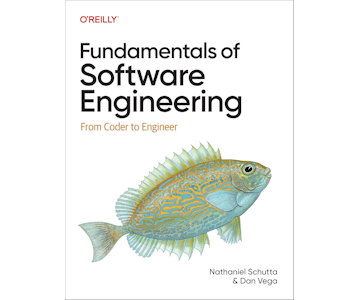
I have just finished reading Fundamentals of Software Engineering: From Coder to Engineer, and it immediately took me back to my early days in the industry. I vividly recall that moment when I first joined a professional team: I knew how to write code, having learned the fundamentals in college, but I quickly discovered that being a software engineer involves a lot more than purely coding.
Welcome to the full Software Development Lifecycle
An activity that, as many of us can attest, is quite frequently the minority of our day. Suddenly, I was faced with the full reality of the Software Development Lifecycle, from figuring out why a massive service is slow to navigating team processes and even the occasional bit of office politics. It felt profoundly overwhelming, especially as I slowly started realising how many crucial practices I didn’t even know I was missing.
The things no one teaches you
This book aims to tackle that challenge. It is an ideal companion for early-to-mid-career developers, whether they come from a traditional Computer Science degree, are self-taught, or followed an intensive bootcamp. Your training gave you the tools (algorithms, syntax), but this book provides the instruction manual for jumpstarting your transition from a coder to an engineer. It will answer many of the questions that you might have that others will view as so-called “common” knowledge and might not even think about mentioning.
Real-World advice from seasoned practitioners
It’s written by Nathaniel Schutta and Dan Vega, two well-regarded figures in the industry. Schutta’s background in software architecture and Vega’s experience as a Spring Developer Advocate help create a pragmatic guide that will help you navigate many of the common pitfalls, be it how to start grasping the codebase (documentation, navigating it, meetings, and so on), the social aspect (politics, meetings, different personal approaches, work-life balance, and so forth), et cetera.
Surfacing the unknown unknowns
Crucially, it is important to note that this book doesn’t claim to teach you absolutely everything required to be a senior engineer; no single title could. Instead, its greatest strength lies in highlighting the “unknown unknowns.” For a junior developer, the most significant obstacles are often the concepts they don’t yet know they need to master, from CI/CD pipelines to architectural drivers, and from effective data handling to code refactoring. The book acts as a comprehensive map of the territory, ensuring they understand what they need to investigate next. The clear chapter layout makes it easy to skip to a specific section if you have a particular need, although I strongly recommend reading the whole book for context.
Beyond Code: people, process, and balance
Beyond the technical skills, such as automated testing and moving to production, I was quite pleased to also see an emphasis on the human side of the craft. The latter is often overlooked, despite how vital these skills are for both our personal well-being and smooth collaboration with everyone. This makes the book a useful guide for anyone feeling slightly overwhelmed by the complexity of modern software delivery, regardless of their educational background. It truly gives the reader the structure to power up their productivity and start engineering solutions.
Recommended resources
After having read the book, I recommend checking these out:
- The Software Engineer’s Guidebook by Gergely Orosz: The book serves as a definitive guide to career progression, laying out the concrete expectations for Senior, Staff, and Principal engineers in a structured, actionable way. It is born from the author’s determination to provide clear feedback and support often missing when aiming for the next level. Where Schutta and Vega establish the engineering foundation, Orosz details how to convert that competence into career advancement.
- The Missing README by Chris Riccomini and Dmitriy Ryaboy: For practical day-to-day operations and a similar “field guide” approach, this is an excellent companion.
- A Philosophy of Software Design by John Ousterhout: If the architectural and design principles in Fundamentals piqued your interest, consider this title, which provides a slightly more advanced dive into managing complexity in code.