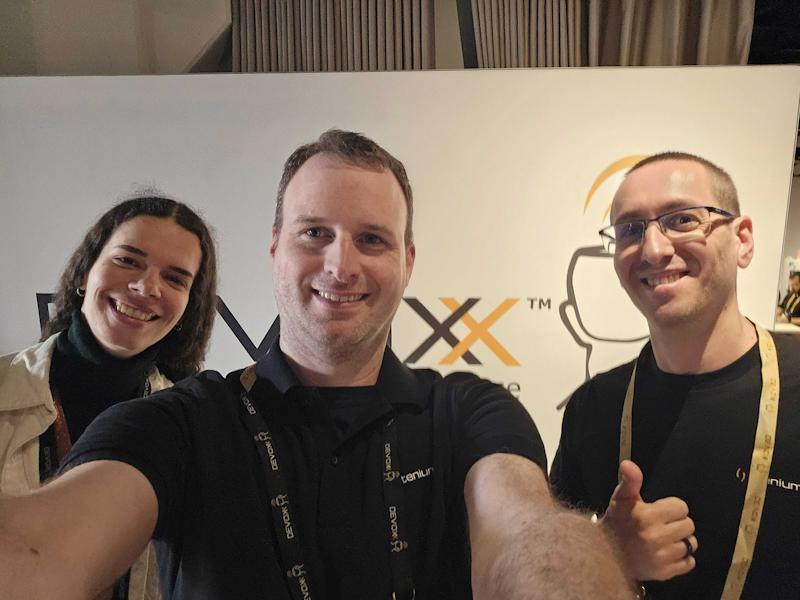
Devoxx 2025
Another magnificent entry with amazing talks on vital topics
🎬 Highlights & Trends
Devoxx Belgium 2025 is a wrap, and it was an edition to remember, with an unmistakable focus on the next evolution in software: AI Agents and the modern Java 25 ecosystem. It is a real treat that the organization put the talks online so quickly, allowing us to dive straight into popular and pressing topics like the Model Context Protocol (MCP), Stable Values, and Structured Concurrency. I’ve since done a deep-dive into the talks, and after some necessary wrestling, this is my top five. This certainly doesn’t take away from the other talks; as always, the quality was amazing.
Summary: Victor Rentea presents typical pitfalls within Event-Driven Architecture (EDA) not as dry theory, but as wild attractions in an amusement park. He covers complex distribution problems such as:
The “Dual Write” nightmare: The problem of atomically saving to a database and sending a message.
Race Conditions: When messages arrive or are processed in the wrong order.
The “Poison Pill”: A message that crashes the consumer and is endlessly redelivered.
Why watch: This is absolutely not dry material. In his typical humorous and energetic style, Victor makes abstract problems very concrete. Definitely a must for developers interested in war stories who want to avoid the practical pain points of messaging systems.
2. Making significant Software Architecture decisions
Summary: Bert Jan presents the complex process of making architectural choices. He warns against “Resume Driven Development” and introduces models to make decisions more objective. A key point is the “Seagull Architecture” anti-pattern: the architect who flies in, drops some decisions, and flies off again without bearing the consequences.
Extra insights:
Trade-offs: Every choice is a sacrifice (e.g., consistency vs. availability).
ADRs (Architecture Decision Records): The importance of documenting why a choice was made.
Fitness Functions: Automatically testing whether your architecture still complies.
Why watch: A beautifully structured, non-dogmatic talk that leans on years of experience. If you are interested in the why behind the what and how of decisions, this is highly recommended.
Summary: Oliver Drotbohm raises critical questions about the hype surrounding Hexagonal and Clean architecture. He questions whether strictly separating technical layers actually serves the right goal.
Core message:
Functional vs. Technical: Focus on vertical slices (functionality) instead of horizontal layers.
Modules: A plea for pragmatic API design (including with Spring Modulith).
Encapsulation: Use Java’s package scope effectively instead of making everything public.
Why watch: A refreshing look that makes you think: how much abstraction do you really need?
Honourable Mention: Backlog.md – Reaching 95% Task success rate with AI Agents
Summary: In this talk, Alex explains how he successfully uses AI agents for software development, ranging from initial frustrations to a structured process.
The Concept: He introduces Backlog.md, where tasks live in markdown files within your git repo.
Context Management: Small, specific tasks prevent the AI from losing track.
Spec-Driven Development: First generate a plan, review it, and only then code.
Why watch: An honest look at the stumbling blocks of AI coding and how to solve them. The project can be found at: https://github.com/MrLesk/Backlog.md